

Expropriation and Real Estate Compensation Lawyer in Riyadh
Legal advice and representation in expropriation and real estate compensation cases — review of the decisions, the valuation, the claims and the related disputes
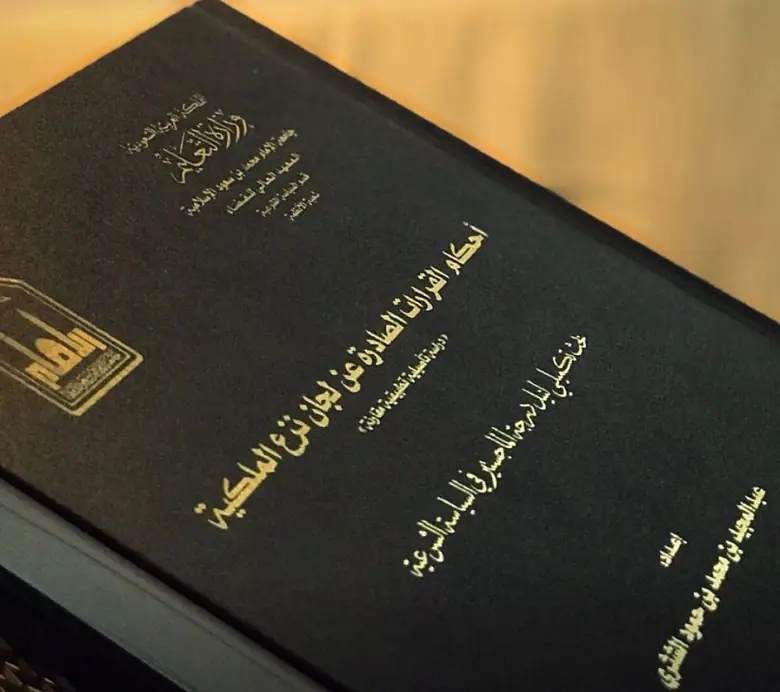
In the image: the cover of the supplementary research prepared by lawyer Abdulmajeed Alshathri for the Master’s degree in Sharia Policy, «Rulings of Decisions Issued by Expropriation Committees» «Rulings of Decisions Issued by Expropriation Committees»
Rulings of Decisions Issued by Expropriation Committees
A foundational, applied and comparative study
Expropriation for the public benefit is one of the matters that require a precise understanding of the statutory procedures and of how compensation is assessed. The firm provides legal advice and representation in reviewing expropriation decisions, assessing compensation, claiming statutory rights and the related disputes, reviewing each case separately on the basis of its documents.
- Type of research
- Supplementary research for the Master’s degree in Sharia Policy
- Prepared by
- Abdulmajeed bin Mohammed bin Hamoud Alshathri
- Institution
- Imam Mohammad ibn Saud Islamic University, Higher Institute of Judiciary, Department of Sharia Policy, Regulations Division
- Academic year
- 1440 AH
Expropriation and compensation under Saudi law
The expropriation of real estate for the public interest and the temporary occupation of real estate in the Kingdom of Saudi Arabia are governed by the Law of Expropriation of Real Estate for the Public Interest and Temporary Occupation of Real Estate, issued by Royal Decree No. (M/56) dated 12/3/1447 AH. This law authorizes the competent authority to expropriate private real estate for public benefit purposes, with an obligation to compensate the owner. Compensation under this law is assessed at the market value of the property, plus twenty percent as compensation for the expropriation.
The procedure begins with the issuance of the expropriation decision by the competent authority and official notification of the owner, followed by assessment of the compensation and presenting it to the owner. A person whose property is the subject of a decision may object to it under the statutory procedures, including the grievance and then the claim before the administrative court within their time limits. Each case is reviewed on the basis of the expropriation decision and the property’s documents to determine the statutory position precisely.
Issuance of the expropriation decision
The competent authority issues a decision to expropriate the property for the public benefit, and the owner is officially notified.
Assessment of compensation
The compensation is assessed according to the rules of the law and presented to the owner for acceptance or objection.
Grievance and appeal
A person whose property is the subject of a decision may object to it under the statutory procedures, including the grievance and then the claim before the administrative court within their time limits.
Assessing compensation and claiming statutory rights
Compensation assessment is a cornerstone of expropriation cases. The compensation offered is reviewed on the basis of the property’s documents and the expropriation decision, and an independent valuation report is prepared when needed to support the objection. The aim is to ensure that the compensation offered reflects the value due under the rules of the law.
The review includes: reading the expropriation decision and identifying the property it covers, reviewing the compensation assessment and its documents, preparing an independent valuation report where appropriate, objecting to the decision under the statutory procedures, and then filing a claim before the administrative court where appropriate. Each step is managed according to the specifics of the case and its documents.
- Reviewing the expropriation decision and official notices.
- Reviewing the compensation assessment and valuation documents.
- Preparing an independent valuation report when needed.
- Objecting to the decision under the statutory procedures, and filing the claim before the administrative court.
Why Abdulmajeed Alshathri’s firm?
Licensed lawyer, licence no. 4281 from the Ministry of Justice.
Accredited real estate registrar from the Real Estate General Authority.
Accredited notary from the Ministry of Justice.
Experience in expropriation cases and compensation valuation.
Specialized research titled: «Rulings of Decisions Issued by Expropriation Committees — A Foundational, Applied and Comparative Study».
Related articles and services
FAQ: expropriation
Can expropriation be refused altogether?
What happens if only part of the property or project is expropriated?
Do I need a lawyer specialized in expropriation?
What documents do I need for my position to be reviewed?

Book your consultation on expropriation or compensation
We review the expropriation decision and your property’s documents to determine the statutory position precisely — contact us now.